Showing posts sorted by relevance for query Hit Shows That Got Off To A Slow Start. Sort by date Show all posts
Hit Shows That Got Off To A Slow Start: The Office
The Ratings Junkie
Tuesday, September 06, 2016
The Ratings Junkie
The Office is one of the biggest comedy hits NBC has offered viewers in many years. In fact, its final season, which was its second-lowest in relative ratings, was unmatched until Superstore came along this season. But in 2005, NBC probably didn't think the show would be so quoted and remembered fondly as it is now. So how did it all begin, and how did it get to where it ended up?
Part 1: The Slow Start
The Office's start reminds me of Seinfeld's in a way; with only six episodes in its first season, NBC had very few data points to go by when deciding whether to renew the show or not, which was based off a popular British show of the same name. What they saw was a 5.0 premiere rating in the A18-49 demographic (stellar retention out of a 5.3 lead-in), but falling all the way down to a 2.3 just barely over a month later (its lead-in then was a 2.8). While those numbers would be instantly renewable today, that 2.3 for the finale was just 56% of the Big 4 average that season. To put this into perspective, that was right in between what Undateable did for its short-lived Friday stint and what The Muppets did towards the end of its short run. And we all know what happened to those shows. But instead of a cancelation, The Office was renewed and it progressed into a hit show.
Part 2: The Raw Growth
Today, it's customary for a show to fall in the ratings, so we look at it in terms of its ratings relative to other shows. Well between the 2004-05 season and the 2005-06 season, there was no league average decline. Though, there probably would have been a little bit of one if The Office didn't rise 41%. The success isn't completely inexplicable; star Steve Carell had become a summer sensation for his lead role in movie The 40-Year-Old Virgin. Still, you wouldn't expect a show to rise that much as a result. What really happened is that NBC had a ton of faith in the show and aired it in some cushy time slots. While it averaged a 4.2 A18-49 rating that season, its lead-in averaged a 5.2, and despite the growth it still barely cracked the league average. But with the show gathering more and more hype and praise, Season 3 remarkably stayed steady (only two hundredths of a drop) despite the average lead-in dropping to a 3.8. The penultimate episode of its third season rose over a demo point from its lead-in, and it kept that same number when its finale was asked to air after local affiliates in a lower-viewed half-hour. Not too shabby. And as its lead-in kept dealing, The Office kept rising. IN its fourth season it was asked to anchor an hour at 9pm on Thursdays, and grew 10% in raw numbers to a 4.5. Its lead-in average was down to a 3.0. So to recap, between Seasons 2 and 4, The Office went from a 4.2 to a 4.5, while its lead-in went from a 5.2 to a 3.0. Sorry for throwing so many numbers at everyone at once, but I think we can all agree that's remarkable. By then, it was at 137% of the league average, a. To put that into perspective, that's right around where The Goldbergs just did this past season, and it's TV's #3 comedy.
Part 3: The Raw Decline, But Relative Growth
By now, DVRs are really setting in and we're no longer seeing seasons where the league average doesn't decline. But now we do, and The Office's 5th season was down 6% (gasp!). Which is extremely remarkable; its lead-in was down to a 2.3. I mean, you almost can't make up how fast its lead-in numbers have declined over the years. That's pretty much the same poor trajectory that The Office itself took in its first season! The Office would proceed to go down 7% and 6% in raw ratings over its sixth and seventh seasons while its lead-in leveled out more or less too. A 3.7 out of a 1.9 in a show's seventh season isn't that bad, obviously, and by this point The Office was simply a phenomenon. Their was huge media coverage when Steve Carell announced it was his final season; it was almost as if the show itself was ending. At 147% of the league average, this was The Office's strongest season ever, and since NBC's league average was just 78% of the Big 4 average, The Office was at almost 190% of NBC's average. That's significantly higher than the two most recent cycles of The Voice.
Part 4: Steve Carell Left, and So Did Viewers
The rest of the story of The Office was rather sad, though remember that it was still massively above its first season's relative ratings, so it still is more than qualified for a "Shows That Got Off To A Slow Start" article. Season 8 was down 26% in raw ratings and 20% in relative ratings, and while NBC's average in general was as pathetic as it was the season before, that's still not a good trend. The show spent the entire 8th season trying to find its voice in a post-Michael Scott world, but viewers bailed big time. By the end of the season, some of the original cast members reportedly told the producers that after the upcoming 9th season it was time to end while they still had some dignity. And viewers kept bailing, down another 24% for its 9th season. Many have said that The Office should have ended after 7 seasons, but NBC was making way too much money off of it for that to happen. You just can't get rid of a show that's doing almost double that of the average. And while The Office continued to make them money, it took for a relatively strong finale for the show to avoid falling under the Big 4 league average for the first time since its first season. But even then, NBC has tried to bring in big stars, air promising new projects out of The Voice, give shows Olympic previews, but none have come close to hitting the heights of The Office. Maybe Superstore will do the same, only time will tell, but it's hard to count on a show growing like that nowadays.
Part 1: The Slow Start
The Office's start reminds me of Seinfeld's in a way; with only six episodes in its first season, NBC had very few data points to go by when deciding whether to renew the show or not, which was based off a popular British show of the same name. What they saw was a 5.0 premiere rating in the A18-49 demographic (stellar retention out of a 5.3 lead-in), but falling all the way down to a 2.3 just barely over a month later (its lead-in then was a 2.8). While those numbers would be instantly renewable today, that 2.3 for the finale was just 56% of the Big 4 average that season. To put this into perspective, that was right in between what Undateable did for its short-lived Friday stint and what The Muppets did towards the end of its short run. And we all know what happened to those shows. But instead of a cancelation, The Office was renewed and it progressed into a hit show.
Part 2: The Raw Growth
Today, it's customary for a show to fall in the ratings, so we look at it in terms of its ratings relative to other shows. Well between the 2004-05 season and the 2005-06 season, there was no league average decline. Though, there probably would have been a little bit of one if The Office didn't rise 41%. The success isn't completely inexplicable; star Steve Carell had become a summer sensation for his lead role in movie The 40-Year-Old Virgin. Still, you wouldn't expect a show to rise that much as a result. What really happened is that NBC had a ton of faith in the show and aired it in some cushy time slots. While it averaged a 4.2 A18-49 rating that season, its lead-in averaged a 5.2, and despite the growth it still barely cracked the league average. But with the show gathering more and more hype and praise, Season 3 remarkably stayed steady (only two hundredths of a drop) despite the average lead-in dropping to a 3.8. The penultimate episode of its third season rose over a demo point from its lead-in, and it kept that same number when its finale was asked to air after local affiliates in a lower-viewed half-hour. Not too shabby. And as its lead-in kept dealing, The Office kept rising. IN its fourth season it was asked to anchor an hour at 9pm on Thursdays, and grew 10% in raw numbers to a 4.5. Its lead-in average was down to a 3.0. So to recap, between Seasons 2 and 4, The Office went from a 4.2 to a 4.5, while its lead-in went from a 5.2 to a 3.0. Sorry for throwing so many numbers at everyone at once, but I think we can all agree that's remarkable. By then, it was at 137% of the league average, a. To put that into perspective, that's right around where The Goldbergs just did this past season, and it's TV's #3 comedy.
Part 3: The Raw Decline, But Relative Growth
By now, DVRs are really setting in and we're no longer seeing seasons where the league average doesn't decline. But now we do, and The Office's 5th season was down 6% (gasp!). Which is extremely remarkable; its lead-in was down to a 2.3. I mean, you almost can't make up how fast its lead-in numbers have declined over the years. That's pretty much the same poor trajectory that The Office itself took in its first season! The Office would proceed to go down 7% and 6% in raw ratings over its sixth and seventh seasons while its lead-in leveled out more or less too. A 3.7 out of a 1.9 in a show's seventh season isn't that bad, obviously, and by this point The Office was simply a phenomenon. Their was huge media coverage when Steve Carell announced it was his final season; it was almost as if the show itself was ending. At 147% of the league average, this was The Office's strongest season ever, and since NBC's league average was just 78% of the Big 4 average, The Office was at almost 190% of NBC's average. That's significantly higher than the two most recent cycles of The Voice.
Part 4: Steve Carell Left, and So Did Viewers
The rest of the story of The Office was rather sad, though remember that it was still massively above its first season's relative ratings, so it still is more than qualified for a "Shows That Got Off To A Slow Start" article. Season 8 was down 26% in raw ratings and 20% in relative ratings, and while NBC's average in general was as pathetic as it was the season before, that's still not a good trend. The show spent the entire 8th season trying to find its voice in a post-Michael Scott world, but viewers bailed big time. By the end of the season, some of the original cast members reportedly told the producers that after the upcoming 9th season it was time to end while they still had some dignity. And viewers kept bailing, down another 24% for its 9th season. Many have said that The Office should have ended after 7 seasons, but NBC was making way too much money off of it for that to happen. You just can't get rid of a show that's doing almost double that of the average. And while The Office continued to make them money, it took for a relatively strong finale for the show to avoid falling under the Big 4 league average for the first time since its first season. But even then, NBC has tried to bring in big stars, air promising new projects out of The Voice, give shows Olympic previews, but none have come close to hitting the heights of The Office. Maybe Superstore will do the same, only time will tell, but it's hard to count on a show growing like that nowadays.
Hit Shows That Got Off to a Slow Start: JAG and NCIS
The Ratings Junkie
Wednesday, January 06, 2016

The Ratings Junkie
JAG
In order to understand NCIS's slow start, it's important to know the background. In 1995, NBC picked up a show named JAG (Judge Advocate General), a drama series about the US Navy. It premiered Saturday at 8pm, which is basically what Friday is today. It had a solid lead-out, The John Larroquette Show, which came in #42 in the season, yet incompatible. Asking a new show to lead off a Saturday is always hard business, and once NBC realized it had the inability to do so, it was moved to Wednesday at 8pm, a night which also included Dateline at 9pm and Law & Order at 10pm, both
top 30 shows. JAG was basically to NBC's Wednesday what The Mysteries of Laura is today. JAG averaged 11.56 million viewers, but only came in as #79 for the season. As such, NBC cancelled it and moved on with their lives.
But not so fast--CBS saw some potential in JAG, and picked it up to anchor Friday nights as a midseason replacement, airing after new sitcom entry Everybody Loves Raymond. The struggling Raymond didn't make it long on Friday nights, upgraded to the post-Cosby spot on Mondays, meaning that JAG took over Fridays at 8 soon thereafter. It still struggled in its second season, barely improving on its first, with an average of 11.80 million viewers and ranking #68 for the season.
Apparently CBS still saw potential in the show, giving it a better time slot (Tuesday at 8) for a third season that presumably many did not see coming. Naturally, it saw significant gains, rising to 12.90 million viewers and ranking #36 for the season. In season 4, it moved up in the rankings to #17 and 14.20 million viewers, marking the first time it cracked the top 20. For the next three seasons, rankings went up and down (#26, #15, #26) while viewership remained between 14 and 15 million for the most part. This is all despite staying in its same Tuesday time slot with no lead-in, meaning that CBS must have made a big promotional push, and word-of-mouth must have spread.
In fact, the show that ranked #79 for its first season went into season 9 with its first-ever spin-off: NCIS, which would take over its Tuesday at 8 time slot, sending JAG back to Fridays for its final two seasons.
NCIS
Unfortunately, the JAG spinoff flopped. Averaging just a 2.73, the outlook did not look bright for NCIS. According to SpottedRatings, a 2.73 in the 2003-2004 season would be equivalent to a 1.13 today. Even at its high, NCIS was only at 76% of the scripted average, and at the low, 52%. That low is even worse than Undateable relative to NBC's average today.
However, due to the network struggling overall, presumed overseas sales, and the fact that something had to face American Idol, NCIS was renewed for a 2nd season. CBS must have been at least a bit pleased at its Season 2 results--although the show was still marginal and never broke the network's average, it also rose 20% year-to-year. And another 20% in Season 3, to an average of 3.92, or about a 1.62 today. For the next two seasons after that, it remained a reliable performer, despite dropping a bit in the ratings. And all this without any lead-in support, getting the same Tuesday at 8 time slot that made it a flop in its first season.
After having an impressive Season 6, where every single rating was above average for the network, it really broke out in its seventh season, where it rose 12% in raw ratings and hit a series high of a 4.8.
That season remains its best yet in raw ratings, averaging a 4.07 in the A18-49 Live+Same Day demo. This may in part have been due to getting its very first spin-off, NCIS:LA, which aired directly after the parent show. Who would have thought that a show that flopped out of the gate, which was the spin-off of another struggling show, would get its own spin-off?
In the 2010-2011 season, it only lost 2% in raw ratings, and at that point it was really considered to be one of the biggest hits on television. Today, it despite double digit ratings declines in each of the last three seasons, the 13th(!) season of NCIS remains one of CBS's top shows. As of this publishing (January 6, 2016), NCIS is the #9 show on all of broadcast, and the #2 show on CBS, only behind The Big Bang Theory. NCIS:LA has declined hard in its move to Monday, but a second NCIS spin-off has been launched (NCIS:NO) that has done fairly well in the ratings, and just tied a series high in a crossover with the parent show. NCIS's rise is definitely one of the most remarkable in recent drama history, and I can see this show finishing with at least 15 or so seasons.
In order to understand NCIS's slow start, it's important to know the background. In 1995, NBC picked up a show named JAG (Judge Advocate General), a drama series about the US Navy. It premiered Saturday at 8pm, which is basically what Friday is today. It had a solid lead-out, The John Larroquette Show, which came in #42 in the season, yet incompatible. Asking a new show to lead off a Saturday is always hard business, and once NBC realized it had the inability to do so, it was moved to Wednesday at 8pm, a night which also included Dateline at 9pm and Law & Order at 10pm, both
top 30 shows. JAG was basically to NBC's Wednesday what The Mysteries of Laura is today. JAG averaged 11.56 million viewers, but only came in as #79 for the season. As such, NBC cancelled it and moved on with their lives.
But not so fast--CBS saw some potential in JAG, and picked it up to anchor Friday nights as a midseason replacement, airing after new sitcom entry Everybody Loves Raymond. The struggling Raymond didn't make it long on Friday nights, upgraded to the post-Cosby spot on Mondays, meaning that JAG took over Fridays at 8 soon thereafter. It still struggled in its second season, barely improving on its first, with an average of 11.80 million viewers and ranking #68 for the season.
Apparently CBS still saw potential in the show, giving it a better time slot (Tuesday at 8) for a third season that presumably many did not see coming. Naturally, it saw significant gains, rising to 12.90 million viewers and ranking #36 for the season. In season 4, it moved up in the rankings to #17 and 14.20 million viewers, marking the first time it cracked the top 20. For the next three seasons, rankings went up and down (#26, #15, #26) while viewership remained between 14 and 15 million for the most part. This is all despite staying in its same Tuesday time slot with no lead-in, meaning that CBS must have made a big promotional push, and word-of-mouth must have spread.
In fact, the show that ranked #79 for its first season went into season 9 with its first-ever spin-off: NCIS, which would take over its Tuesday at 8 time slot, sending JAG back to Fridays for its final two seasons.
NCIS
Unfortunately, the JAG spinoff flopped. Averaging just a 2.73, the outlook did not look bright for NCIS. According to SpottedRatings, a 2.73 in the 2003-2004 season would be equivalent to a 1.13 today. Even at its high, NCIS was only at 76% of the scripted average, and at the low, 52%. That low is even worse than Undateable relative to NBC's average today.
After having an impressive Season 6, where every single rating was above average for the network, it really broke out in its seventh season, where it rose 12% in raw ratings and hit a series high of a 4.8.
That season remains its best yet in raw ratings, averaging a 4.07 in the A18-49 Live+Same Day demo. This may in part have been due to getting its very first spin-off, NCIS:LA, which aired directly after the parent show. Who would have thought that a show that flopped out of the gate, which was the spin-off of another struggling show, would get its own spin-off?
In the 2010-2011 season, it only lost 2% in raw ratings, and at that point it was really considered to be one of the biggest hits on television. Today, it despite double digit ratings declines in each of the last three seasons, the 13th(!) season of NCIS remains one of CBS's top shows. As of this publishing (January 6, 2016), NCIS is the #9 show on all of broadcast, and the #2 show on CBS, only behind The Big Bang Theory. NCIS:LA has declined hard in its move to Monday, but a second NCIS spin-off has been launched (NCIS:NO) that has done fairly well in the ratings, and just tied a series high in a crossover with the parent show. NCIS's rise is definitely one of the most remarkable in recent drama history, and I can see this show finishing with at least 15 or so seasons.
Hit Shows That Got Off to a Slow Start: Seinfeld
The Ratings Junkie
Monday, December 28, 2015
The Ratings Junkie
| Logo for Seinfeld, then titled The Seinfeld Chronicles, in 1989 Source: Wikia |
Yet NBC still went ahead and green-lit a fourth season. Ratings declined a little, yet not as much as the rest of television, and the show had worked its way up to #30. By midseason, it was moved back to Thursday at 9:30, behind Cheers again, as in its Wednesday time slot it started to perform as well as Wings, which was concurrently holding the post-Cheers time slot. Since The Cosby Show had ended, Thursday at 8 and 8:30 had become a struggle in the ratings for NBC, so moving Wings to the 8:30 time slot and the relatively promising Seinfeld to 9:30 seemed to make sense. It hit a peak of 32.8 million viewers that season, showing that a time slot can mean everything. Interestingly enough that episode was titled "The Pilot", where the characters in the show were making a pilot about their lives--the fake pilot, titled Jerry, is basically what Seinfeld is already about. Due to its success midseason, it rose to the #25 program of the season. NBC was definitely making a very brave decision to move it there considering it had its chance a couple seasons ago and blew it.
That would turn out to be the final season of Cheers, meaning NBC had to make yet another very brave decision in the 1993-1994 season: move Seinfeld to the Thursday at 9 anchor time slot, AND launch a new show, Frasier. This pairing was simply unstoppable--Seinfeld finished the season as the #3 program on TV, and Frasier as #7. Wings also did well at 8:30 as the #18 program, though the 8pm time slot was still trouble. It averaged a 19.6 HH rating and 29.6 million viewers, almost 10 million more than the previous season. Overnight, Seinfeld grew into a cultural sensation and was the cornerstone of NBC's Must See TV Comedy Thursday.
The next season, Seinfeld became the #1 program, averaging just over a 20 HH rating and 30 million viewers. This is all despite losing its lead-in (Wings) and lead-out (Frasier), both asked to anchor a Tuesday night due to protests from higher-up executives against the Head of Scheduling for wanting to go all-unscripted on the night (remember, this is in the pre-Survivor era, where unscripted meant Dateline, Unsolved Mysteries, etc.
The 8:30 show on Thursday night, a little show named Friends, had a promising start and was moved post-Seinfeld midseason, ending as the #8 program of the season. Hope and Gloria, madam of the People, and even Mad About You were also Top 15 shows on NBC's Thursday night that season. All of a sudden, Seinfeld was unstoppable, and nothing else they aired on the night was either. It was the #2 program on TV for its next two seasons, and rose back to the top spot in its 9th season, which was also the last season due to Jerry Seinfeld, star, writer, and creator, wanted to end it. The finale had 76.3 million viewers and a 58 share; the clip show that aired before it had 58.5 million viewers and a 53 share. Quite a long way for the show has come over its nine seasons.
![]() |
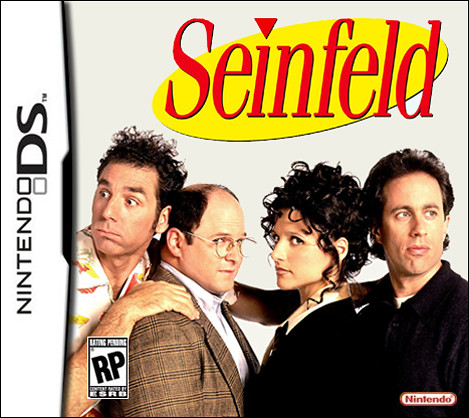
| Fan-made cover art for a Seinfeld Nintendo DS game in 2006 sparked many people voicing support for the idea (which never happened). |
Today, Seinfeld is in constant rotation in syndicated reruns, and is considered to be one of the best comedy series of all time. It's a classic example of a show that was given a first, second, and third chance, and eventually grew to be the legendary show it is known as today. Constant references are made to the show and its characters, DVD box sets have become massive sales generators, and it was simply irreplaceable.
Yet it is very rare that a show gets so many chances to grow in the ratings. Seinfeld is a rare outlier success story that is constantly cited today as a reason why networks should give x show another chance. While fans constantly overlook the fact that the chances their show turns into another Seinfeld in relative ratings, it is truly impressive to look back and see how unique Seinfeld was in ratings trajectory.
Hit Shows That Got Off to a Slow Start: SpongeBob Squarepants
The Ratings Junkie
Wednesday, December 30, 2015
The Ratings Junkie
When SpongeBob SquarePants premiered in May of 1999, Rugrats was braking records for the children's cable channel. In fact, according to a Variety article, the 1999 season premiere of Rugrats pulled in 5.5 million viewers and a 35 share amongst Nickelodeon's prime demographic: children between the ages of 2 and 11. This was also the period of Hey Arnold and other animated Nickelodeon shows still talked fondly about today. Nickelodeon had every intention to turn SpongeBob into another big animated hit for them, airing its series premiere after the Kids Choice Awards--which is like the Super Bowl of Nickelodeon.
So the title of this article is slightly misleading--the Kids Choice Awards propelled SpongeBob's premiere to a whopping 6.9 million viewers. Interestingly enough, only 3.6 million were between the ages of 2 and 11, showing that SpongeBob was appealing to all audiences.
Or was it? Despite generally favorable reviews, the second original airing had only 1.9 million viewers, losing 5 million viewers from its premiere, or 72.5% of its audience. Let's put this into perspective: if a broadcast show today premieres to, say, a pretty realistic 1.8 A18-49 rating, that kind of percentage drop would give its second episode a 0.5 rating. SpongeBob was trailing their hits by a wide margin, despite the great exposure it got for its first episode. There aren't a ton of data points available for first season viewership, but it seems that it stabilized in the 2.0-2.1 million viewers range, nothing to write home about.
It was said that SpongeBob was primarily renewed for another go-around because of merchandise sales. They stated to air promos where they would advertise the struggling show alongside some of their hits, aired marathons, etc to make sure their renewal wouldn't turn out to be a mistake.
Indeed it was not. SpongeBob continued to grow in its second and third seasons, which was followed by a theatrical film release in 2004. Originally planned to serve as the series finale, the movie did too well in the box office (made $140.2 million with a $30 million budget) Nickelodeon to realistically end the show, considering 2004 was also the year they retired Rugrats after a decade on the air.
In the third episode of its fifth season, which aired in November of 2005, SpongeBob lost his pet snail Gary. 7.93 million people tuned in to see if Gary would be found. That's more viewers than most broadcast shows today have. But it didn't end there. The following February another episode had 8.6 million viewers, and the show was far and away the most popular animated children's show. Everyone knew the theme song, everyone knew who SpongeBob, Patrick, etc was, and Nickelodeon surely wasn't regretting renewing it after its first season.
Its series high would occur on November 12, 2007, when an episode titled "Atlantic SquarePantis"
was watched by 9.22 million viewers. By Seasons 6 and 7, regular, non-special episodes stabilized between 3.5 and 6 million viewers, with specials going even higher.
Season 8, which aired in 2011 and 2012, saw very significant ratings declines, though most episodes were still between 3 and 4 million viewers, an excellent number that every other Nickelodeon show could dream of.
The currently-airing Season 9 is probably its most unstable yet. Original episodes have pulled in between 1.3 and 5.2 million viewers, and ratings have rapidly declined as of late. This may have to do with the fact that SpongeBob is on practically all-day long now--these newer episodes are doing what a typical rerun would do. The season started in 2012, but regular episodes have come in more sporadically as the team was working on a second theatrical release, which had double the budget of the first film in 2004. As of this writing, it has pulled in $323.4 million, making it far and away more successful than the first.
SpongeBob remains a massively popular television show today. A chart made by Nielsen and published by Bloomberg shows that in 2014, SpongeBob aired for nearly almost 100,000 minutes cumulative, meaning that 18% of Nickelodeon's programming is now either an original or rerun of SpongeBob. Also in 2014, over 3,000 telecasts of the show were airing, approximately doubling those shown 10 years ago, which was also an above average amount of time considering how many shows Nick/Nick at Nite has. The show has also made billions in endorsements and merchandise sales, and has lasted throughout many of Nickelodeon's eras.
In case you were wondering, SpongeBob was renewed for a 10th season in 2013, but due to the movie production has only started a couple months ago. It will be the first post-2004 movie season where series creator and former Stephen Hillenburg will be involved in the making of the episodes, though not as show runner, and his replacement show runner is exiting.
So the title of this article is slightly misleading--the Kids Choice Awards propelled SpongeBob's premiere to a whopping 6.9 million viewers. Interestingly enough, only 3.6 million were between the ages of 2 and 11, showing that SpongeBob was appealing to all audiences.
Or was it? Despite generally favorable reviews, the second original airing had only 1.9 million viewers, losing 5 million viewers from its premiere, or 72.5% of its audience. Let's put this into perspective: if a broadcast show today premieres to, say, a pretty realistic 1.8 A18-49 rating, that kind of percentage drop would give its second episode a 0.5 rating. SpongeBob was trailing their hits by a wide margin, despite the great exposure it got for its first episode. There aren't a ton of data points available for first season viewership, but it seems that it stabilized in the 2.0-2.1 million viewers range, nothing to write home about.
It was said that SpongeBob was primarily renewed for another go-around because of merchandise sales. They stated to air promos where they would advertise the struggling show alongside some of their hits, aired marathons, etc to make sure their renewal wouldn't turn out to be a mistake.
Indeed it was not. SpongeBob continued to grow in its second and third seasons, which was followed by a theatrical film release in 2004. Originally planned to serve as the series finale, the movie did too well in the box office (made $140.2 million with a $30 million budget) Nickelodeon to realistically end the show, considering 2004 was also the year they retired Rugrats after a decade on the air.
In the third episode of its fifth season, which aired in November of 2005, SpongeBob lost his pet snail Gary. 7.93 million people tuned in to see if Gary would be found. That's more viewers than most broadcast shows today have. But it didn't end there. The following February another episode had 8.6 million viewers, and the show was far and away the most popular animated children's show. Everyone knew the theme song, everyone knew who SpongeBob, Patrick, etc was, and Nickelodeon surely wasn't regretting renewing it after its first season.
Its series high would occur on November 12, 2007, when an episode titled "Atlantic SquarePantis"
was watched by 9.22 million viewers. By Seasons 6 and 7, regular, non-special episodes stabilized between 3.5 and 6 million viewers, with specials going even higher.
| Wikia |
The currently-airing Season 9 is probably its most unstable yet. Original episodes have pulled in between 1.3 and 5.2 million viewers, and ratings have rapidly declined as of late. This may have to do with the fact that SpongeBob is on practically all-day long now--these newer episodes are doing what a typical rerun would do. The season started in 2012, but regular episodes have come in more sporadically as the team was working on a second theatrical release, which had double the budget of the first film in 2004. As of this writing, it has pulled in $323.4 million, making it far and away more successful than the first.
SpongeBob remains a massively popular television show today. A chart made by Nielsen and published by Bloomberg shows that in 2014, SpongeBob aired for nearly almost 100,000 minutes cumulative, meaning that 18% of Nickelodeon's programming is now either an original or rerun of SpongeBob. Also in 2014, over 3,000 telecasts of the show were airing, approximately doubling those shown 10 years ago, which was also an above average amount of time considering how many shows Nick/Nick at Nite has. The show has also made billions in endorsements and merchandise sales, and has lasted throughout many of Nickelodeon's eras.
In case you were wondering, SpongeBob was renewed for a 10th season in 2013, but due to the movie production has only started a couple months ago. It will be the first post-2004 movie season where series creator and former Stephen Hillenburg will be involved in the making of the episodes, though not as show runner, and his replacement show runner is exiting.
Bake Your Heart Out Season 1 Episode 10 - Bake Your Heart Out: Behind The Sweets
Bake Your Heart Out Season 1, Episode 10
Bake Your Heart Out: Behind the Sweets
Diane: Hello faithful viewers of Bake Your Heart Out! Tonight, we’re doing things a bit differently.
Sam: We’re celebrating five years of our show tonight with a special documentary ahead of next week’s big premiere, showing you
Diane: We’re going behind the scenes to show you the action you’ve been dying to see. Or behind the sweets, if you will.
Sam: We should probably kick things off at the very beginning. Here’s our producer, Leslie, to talk about that.
The camera cuts to Leslie, sitting inside the Baking Cabin.
Leslie: Where should I begin? I guess at the beginning like Sam and Diane said I would. It was 2013 when I first had the idea. There had been a bunch of baking shows on cable before. There was a whole network about baking. Watching the Baking Channel every night when I got home from a long nine to five job was what inspired me to create Bake Your Heart Out. It relaxed me, and I wanted to be able to give that gift to other people. I worked in television before but wasn’t successful enough to make a career out of it. Believe it or not, I was a comedy writer for my first five years working in television. Every show I worked on got canceled and I went into the private sector. I then used some of my old connections to help me get Bake Your Heart Out off the ground. No network wanted to dedicate an hour of their schedule to a show about baking. One of the network executives said that only old ladies would watch the show. Some of my friends expressed their doubts. I didn’t think we’d get it to work. I didn’t want the show to air on the Baking Channel because it wouldn’t really stand out there. Three networks turned the show down. It took until the fourth network until anyone showed some interest. Paul McVann, the head of that fourth network, believed in us. He said his wife loved the idea and thought it would be a hit. He talked about it with some of the executives and he pushed them until they agreed to order it. Then he shocked the TV world by placing it on Thursdays at 8 o’clock. It aired into Ballroom Celebrities, hosted by our current president and then the network’s number one show.
The camera cuts to Paul sitting at his desk in his office.
Paul: The show was a surprise hit to most. Not to me, I knew it had something special. I remember the headlines in the trades. “MBC bakes up ratings gold” was my favorite. We ordered ten more episodes the day after it premiered. It was for a whole new group of contestants and there were a few months in between the filming of the first ten episodes and the next ten, so it was essentially us renewing it the day after the premiere. That’s unheard of, but we had so much faith in this show and we needed to prove it in a big way.
The camera cuts to Frances and Garry in the Baking Cabin, sitting at the table they frequently sit at during judgment.
Frances: Early on in Bake Your Heart Out? It was pretty much the same as it is now. I just made less money. Other than that, everything’s the same. Leslie really had to work hard to get me on this show, I was doing my own show on cable when she first kicked around the idea, but she was persistent and she got me after continued pestering.
Garry: On the other hand, Leslie only had to ask me once for me to accept it. My show on the Baking Network was canceled, just like the three shows I had prior to it. I was so emotional just getting the call because I was shocked anyone would want me to be on their shows since I was starting to be considered “ratings poison.”
Frances: I heard you weren't the first choice. It was supposed to be DeAnna Clifton but I need that idea.
Garry: What? How have I never heard this before?
Frances: Probably because I just made it up.
Garry: You little…
The camera cuts to Sam and Diane, sitting in Sam’s dressing room.
Sam: Oh look, it’s back to us.
Diane: That was quick!
Sam: Got anything to add to this conversation?
Diane: Nope, got nothing.
Sam: Nothing? Surely you have some interesting
Diane: My memory just isn’t firing on all cylinders today, I guess.
Sam: I have a story. I think it was September 2014. I’m at a bar, drowning my sorrows after the end of our comedy tour that summer. You gave me a call and said your agent called and told you they wanted us to host this thing. My agent didn’t call me because of the fact that he’s terrible, so thankfully yours did. The rest is history.
Diane: Speaking of history…
Sam: Oh yes! A chat with all of our winners. Coming up, after the break!
After the commercial break, Sam and Diane meet up with the show’s winners.
Sam: Welcome back guys! You are, without a doubt, the greatest bakers to enter our little cabin. I think I should go to our first winner, Martha. Martha, you are a grandmother who spoke frequently about baking with her grandkids. America loved you so much. How has your post-Bake Your Heart Out life been and how does it feel to be the winner that started it all?
Martha: I never thought I’d even come close to winning the show, so it was definitely shocking to be considered by so many to be the one who kicked it off -
Diane: I think it would’ve been truly disingenuous if people didn’t. You were our first winner and people connected to you so much that it helped make us a hit.
Martha: That means so much to hear you say that. I never started baking to win any prize or titles. I competed against people who were so notable online and in the baking circuit, I thought I’d be out first. It’s truly been an honor to even be discussed as part of the show’s legacy. I can’t thank you two and Frances and Garry and the entire crew enough.
Diane: We can’t thank you enough for being here for this celebration.
Sam: This has been a show that’s traditionally been dominated by women. Five of our eight winners are women and seventeen of twenty-four finalists were women. Elliott, how did it feel to be the first male winner?
Elliott: I was surprised I won. What else can I say?
Diane: Hopefully something else since we gotta fill some more time with this segment.
Elliott: I’m just honored to have the same title Martha holds. Is that enough?
Diane: We’ll take it!
Sam: Pam, I’ll throw this question to you since you’re the only one here who knows this feeling. What was it like to be in the bottom two the first week of the competition and ultimately win the whole thing?
Pam: Well Sam, I’ve always been told slow and steady wins the race. It’s not how you start the journey, it’s how much you grow during it. Falling into the bottom two really lit a fire under me and made me realize that baking as good as I did back home in Kansas wasn’t going to cut it here and I had to learn fast. It humbled me and it made me better. At the very least it gave me a cool story. Sorry Kathy, you winner Top Baker eight weeks out of nine is pretty impressive too.
Kathy: Why thank you!
Diane: I think since her name was invoked we’ll throw Kathy the next question. What’s it like to be our most dominant winner ever and how did that affect your performance in the final bake?
Kathy: I didn’t like to think of it that way during my season. Winning Top Baker the most doesn’t guarantee you the win. So, I tried not to let myself think I had it in the bag since the other two in the finals were outstanding as well, otherwise, they wouldn’t be there. It took the pressure off and helped me win. Now, it’s certainly been fun to have that record now that the season’s over. It helps me brag a bit more when I say I won Bake Your Heart Out. My baking friends back home in Virginia are a little jealous, I won’t lie.
Diane: Sabrina, you were pregnant during the season that you won. How has your life been since you’ve given birth? How much are you baking?
Sabrina: Life’s been so good since I won and had my Jamie. Things are different, I can’t lie. I haven’t been baking as much, and when I do get to bake, it’s not quite to the level of quality. However, I can sacrifice that for the joy of spending time with my baby. That’s priceless.
Diane: Sabrina, I say this as the mother of adults. Enjoy all of that time. They aren’t as adorable when they’re thirty and living across the country.
Sabrina: I promise, I’ll enjoy it as long as I can.
Diane: Good girl!
Sam: Sharita, you’re the winner of what many called our most competitive season ever. Three contestants won Top Baker three times each. What was it like to win a season where everyone so evenly matched?
Sharita: I think that made the win even more meaningful. Knowing that I was playing against two people who had beaten me for Top Baker at some point, it put a lot of pressure on me to perform my best. I perform better under pressure than when I’m feeling confident. I think it helped me when it probably could’ve hurt some other people who let it get to them.
Diane: One more quick question for Thomas. You’re the most recent winner we’ve had. What would you like to see on this upcoming season from the bakers?
Thomas: Less relying on baking cakes. I like to say that my season was the “season of cake” because it felt like someone was baking one every week even if it didn’t make very much sense. So, less of that and including some of the more obscure desserts. As a viewer, I just love to see people bring up some lesser-known recipes that they have a deep connection to. It’s what makes this show special.
Sam: Thank you guys for being here. We’re sorry that Rob, who was our sixth winner, couldn’t make it here for this reunion, but he was here in spirit. After the break, we count down our favorite moments in the history of Bake Your Heart Out. Stay tuned.
After the commercial break, the camera goes back to the Baking Cabin, where Leslie is sitting.
Leslie: It’s so hard to point out my favorite moments of the entire series. This isn’t necessarily a moment “from” the show, but that first promo that aired on national TV, promoting a show that I created, that was pretty cool. It finally made me feel like I made the right decision moving to California. As far as actual moments from the show, I think I’d have to go with the third cycle’s finale. Sabrina’s seven swans-a-swimming cake that featured a functional chocolate fountain actually made me tear up, it was so gorgeous. It was at that moment that I knew we had to do a Christmas special every year.
The camera pans to Frances and Garry.
Frances: My favorite moment? Garry, you got anything?
Garry: When do I?
Frances: Good point. There is one moment that stands out to me, though. Thomas’s third bake of Bread Week, in our eighth cycle. Somehow six of the other seven people left in the competition managed to somehow make bread that was also cake, so Thomas coming out with a good, old-fashioned challah baked into the shape of a birdhouse was very much appreciated. It helped that it was so well done. Seeing that beautifully-crafted piece at the end of a frustrating day was incredibly rewarding.
Cameraman: Thomas talked about the over-use of cake that season during his interview with Sam and Diane.
Frances: Oh, did he? I always knew I liked him.
Garry: My favorite moment was the technical challenge in the fourth cycle, where the contestants all had to bake a Religeuse and nobody had ever made one before and most hadn’t heard of them.
Frances: Oh yeah, that was a fun one.
Garry: I think one of them just made a sponge cake filled with peanut butter. I don’t even know how they possibly did that.
Frances: I think one of them started on fire. It was such a disaster.
Garry: Even the winning bake was horrible.
Frances: Was it Hank that won that one? I remember his bake tasting like he dumped sand in it, but he still won because the other ones were so embarrassing.
Garry: Is that the reason we stopped doing France Week?
Frances: That and because Twitter called our French accents “offensive” and “so bad I want to stab my eardrums.”
The camera cuts back to Sam and Diane.
Sam: So what’s your favorite Bake Your Heart Out moment, Diane?
Diane: Any time I get to eat. I’m a big fan of sweets.
A two-minute montage of Diane eating various bakes over the course of the show is shown.
Sam: Wow, that’s a lot of eating.
Diane: You did it, too. Speaking of which, what’s your favorite moment?
Sam: I’d have to go with the time we went to New Orleans for the third season premiere. It was so much fun being down there and we got to eat so much great food. Beignets, muffuletta sandwiches, king cakes, bread pudding… and that was just what the contestants made!
Diane: That was a fun week. And there’s more fun after the break, so stay tuned!
After the commercial break, Sam and Diane are standing in the Baking Cabin, during the filming of the show.
Sam: Oh, hey! We’re back, and we’re finally giving you viewers a look at Bake Your Heart Out behind the scenes. We’re in the Baking Cabin about an hour ahead of the filming of our next episode.
Diane: As you can see, things look a little different now than what you usually see on the show. For starters, there’s a ton of people in the cabin right now, working hard to bring it up to tip-top shape. That’s not something you usually see.
Sam: And also, as the cameraman is showing you right now, this isn’t really a cabin in the middle of the woods. We’re based on a soundstage in California, and this isn’t even a functioning building. It may have four walls, but it doesn’t even have a roof.
Diane: We sure do wish it was a cabin in the woods in New Hampshire sometimes because it can be a scorcher out here in LA and especially here in the cabin, but luckily our crew is pretty forgiving when Sam, Frances, Garry or I need to escape the heat from the ovens and the hot stage lights. Not only do they have high-powered fans just outside of the cabin, we’re also allowed to go to our dressing rooms if we need to get cool. I can assure you, we do make it as chilly as possible in there. Let’s go take a look at ‘em!
They take a walk to Diane’s dressing room.
Diane: So this is my dressing room. I lost a game of rock-paper-scissors on day one of filming and I got the smallest dressing room of the four of us. I did the most I could with it. Here’s a picture of me with my kids, and there’s a picture of me with a bunch of cast members from Survivor. They’re our competition but Frances and I watch it every week together on FaceTime.
Sam: I think Diane has a crush of Jeff Probst.
Diane: I do not! He’s married!
Sam: That doesn’t mean anything!
Diane: Moving on, here’s the couch that I will come sit on and scroll through Instagram and whatnot when filming isn’t on. You can see the giant fan here and the air conditioner because as I said, it’s a scorcher out in that cabin. There’s a picture of my family hanging on the wall above the couch, including my twin sister Diana who looks just like me. She could replace me on this show and you’d never know it! And here’s my closet, full of all my dresses I’ve worn on the show since the very first episode. I don’t technically own most of them so I can’t take them with.
Sam: I own all of my suits, though.
Diane: Well, you only wear like four different ones so that’s not much of an accomplishment.
Sam: Touché.
Diane: Let’s go take a look at Sam’s dressing room while we’re on the subject of her wardrobe.
Sam: Oh boy.
Sam and Diane walk to Sam’s dressing room.
Sam: Well, here it is. The ole’ dressing room. Pretty fancy, I know.
Diane: Sam won the game of rock-paper-scissors.
Sam: Sure did! As you can see, it’s painted red with gold trimming to symbolize my classical training in the theatre. It’s filled with some things that bring to mind the comforts of home life. A picture of my wife, Nicolle. A framed copy of the Fleetwood Mac Rumors album. Pictures with me and three of the last five presidents. A mini-fridge filled with my favorite drinks and snacks. A microwave so I can make my teas. Most importantly, my Bake Your Heart Out contract from five years ago.
Diane: How’d you get that? Didn't the network take it?
Sam: I made a copy of it. Paul let me.
Diane: I should’ve thought of that! How did I never notice you had that?
Sam: Diane, I think you’re forgetting we’re on camera right now. We’re working.
Diane: Oh, right! Anything else you’d like to point out in this red ice-filled cavern?
Sam: Nope!
Diane: Then let’s go talk with Leslie! Oh, hey Clint!
Sam: Clint, our reliable stage director everybody! You don’t get to see him on the show but we love him!
Clint: Aww, thanks.
Sam and Diane head to Leslie’s office.
Diane: Now, this room is going to be significantly less opulent.
Leslie: Oh hey guys! Are you really bringing cameras in this messy room?
Sam: Of course! You’re the reason you’re all here, the viewers need to see where you operate!
Leslie: Here it is. Nothing special. Just a tiny little office. Plans for the next few weeks of filming are here on my desk. Typing up another week’s plans on my computer. Already getting to work on casting for the big tenth cycle. Lots of fun things but not anywhere to show for it.
Diane: Who are these people on the wall? That’s a fun touch to this plain little white room.
Leslie: Those are my parents. Both Oklahomans born-and-raised. They’re the biggest fans of this show.
Diane: Anything else to show us before we go bug Frances?
Leslie: Nope! Go do what you have to.
Sam: See ya, Leslie!
Sam and Diane walk to Frances’ room.
Frances: My goodness! What are you guys doing here?
Diane: Just giving the viewers what they want.
Frances: What would that be?
Diane: A look at your dressing room!
Frances: Oh! Well, here it is. The second-biggest one in the place. I came in second at rock-paper-scissors on the first day of filming!
Diane: I love how we all remember that game vividly.
Sam: Of course we do. It’s what separated us from getting an awful room like you got stuck with from a gorgeous one like mine. Anyway, Frances, show us around a bit!
Frances: I have a real treat for you guys.
Diane: Can’t wait!
Sam: Frances, what is that?
Frances: That would be a cage.
Diane: I think I know what our treat is!
Frances: This is Mr. Snuggles! He’s my white Persian cat who has provided me so much comfort in the past year. He’s also on Instagram and Twitter as of last week. 24 thousand followers already, I’m very proud of my little guy.
Diane: I’ve never met him before! Hello there, Mr. Snuggles!
Sam: Anything else special in here you want to show the world?
Frances: Yes! My signed picture of me with some of my favorite Survivor castaways. Isn’t that so cool?
Diane: I showed them the same thing!
Sam: Seriously, is this like a stealth Survivor promo? We’re talking about that show a lot tonight.
Frances: It’s our favorite show!
Diane: Besides Bake Your Heart Out, obviously.
Sam: I guess it’s time to go check on Garry in his dressing room.
Frances: He’s probably sleeping, you better not wake him. He gets grumpy.
Sam: Don’t worry. We will.
Sam and Diane walk to Garry’s dressing room.
Diane: You awake, Garry?
Garry: Yes, I’m just in here texting with Carly!
Diane: Mind if we bring a camera or five in here with us?
Garry: I don’t know what it’s for, but sure. Bring ‘em in!
Sam: We’re here to give our fans a shot of your dressing room for the big documentary!
Garry: That’s great! My most devoted social media followers have already seen a shot of my room, but I’ll let everyone see.
Sam: Anything special in here?
Garry: Taped to my mirror is something that’s the most special.
Diane: Is that Carly’s ultrasound?
Garry: Indeed it is!
Diane: Aww, it’s so sweet you keep it in here.
Garry: Just gotta remind me of what I have to look forward to in the near future.
Diane: It’s so exciting that you’re going to be a father in just a few short months.
Sam: I remember attending your wedding. We were only working together for about three months at that time, but I knew then it would be a forever friendship.
Garry: That is genuinely the kindest thing you’ve ever said to me.
Sam: I’m softening. It scares me.
Diane: No you’re not. Don’t worry, Sam.
Sam: Anyway, moving away from my own personal journey to being kinder, got anything else fun to show us, Garry?
Garry: Not too much. It’s not a very fancy dressing room. It’s not like Sam’s.
Sam: My dressing room isn’t that fancy.
Garry: You have a water fountain.
Sam: It’s very small.
Diane: While Sam and Garry argue about their dressing rooms, we’re gonna take a break. When we get back, a special message from the Bake Your Heart Out family.
After the commercial break, Sam, Diane and Garry are seen standing in the middle of the Baking Cabin.
Diane: Hey there, Bakers. You have been the sweetest, kindest, most lovingly devoted fanbase imaginable. The love you’ve shown us has truly changed our lives. Between the kind messages on social media, to the lovingly-written pieces of fan mail, we appreciate it all. That’s why we have to be honest with you.
Garry: We’ve always said that Bake Your Heart Out was a journey we’d only be a part of if our hearts were 100% in it.
Sam: Sadly, that’s no longer the case. It’s not that we don’t love working together anymore or working on the show anymore. It’s the best experience of all of our lives, and we appreciate every moment.
Diane: Sometimes, though, it becomes clear to you that you have to move on.
Sam: That’s why, when the fall run of the Bake Your Heart Out concludes in December 2019, Diane, Garry and myself will leave Bake Your Heart Out for good.
Garry: It’s been a wonderful ride,
Sam: And we’ve loved every moment of it,
Diane: But farewell is on the horizon. Thank you to our faithful viewers, who have helped make Bake You're Heart Out into what it is today. We wouldn’t be here without you.
Sam: Literally. Without you all watching, there wouldn’t be a show for us to leave.
Diane: This isn’t goodbye. We have ten episodes remaining together.
Garry: We’ll use them to provide the same fun, relaxing, inspiring show we’ve given you for the past five years.
Sam: Thank you.
Garry: Thank you.
Diane: Thank you. From the bottom of our hearts. The show will remain in good hands. With you, the fans, and Frances and Leslie and the amazing crew here.
Sam: That’s it for Bake Your Heart Out: Behind the Sweets. From all of us here, thanks for watching. Make sure to tune into the season premiere of Bake Your Heart Out next week! Bye-bye!
What did you think of the episode? Let us know in the comments and make sure to return next week for another new episode!
Subscribe to:
Posts (Atom)